
Nara Full-Day Private Tour Osaka/Kyoto departure with Government-Licensed Guide
Nara Full-Day Private Tour Osaka/Kyoto departure with Government-Licensed Guide
Explore Nara with a government-licensed and experienced multilingual guide! Your guide will help you efficiently enjoy a full-day walking tour of Nara and introduce both modern and traditional sides of this dynamic and ancient Japanese city.Nara's proximity to Kyoto and Osaka, and its rich collection of traditional sites, make it an ideal destination for a day trip from either of its larger neighbors. Your private guide can help you efficiently enjoy a full-day walking tour of this ancient Japanese city.You can start your day at your hotel in Osaka, Kyoto.
Let us know what you would like to experience and we will customize Nara day tour that's best for you!Note*1: Please select your must-see spots from a list in the tour information to create your customized itinerary.Note*2: The National Government Licensed Guide Interpreter certification is issued by the Japanese government requires a good knowledge and understanding of Japanese culture and history.
Book This ExperienceA glimpse of the journey




Your Itinerary
A curated journey through the experience
Todai-ji Temple
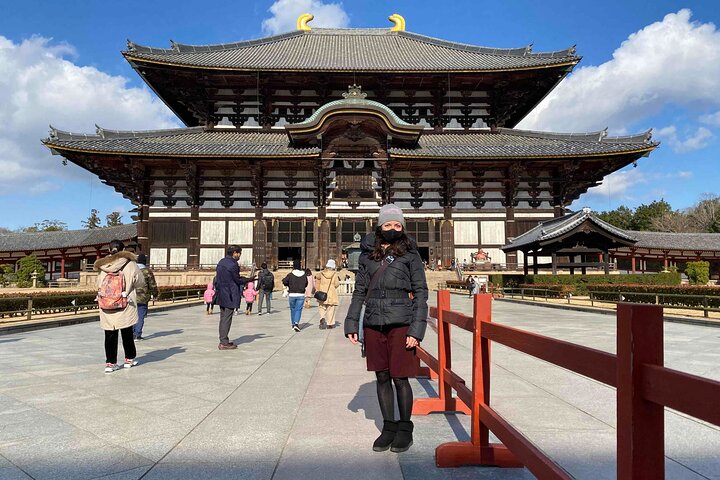
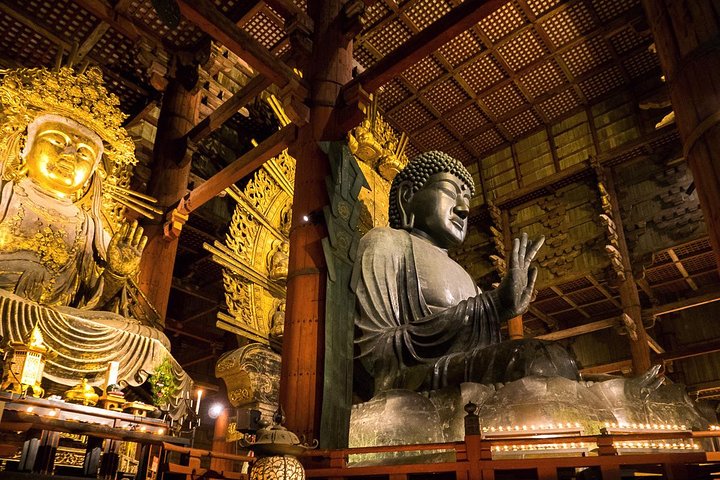
Until recently, Todaiji's main hall, the Daibutsuden (Big Buddha Hall), held the record as the world's largest wooden building, despite the fact that the present reconstruction of 1692 is only two thirds of the original temple hall's size. The massive building houses one of Japan's largest bronze statues of Buddha (Daibutsu). The 15 meters tall, seated Buddha represents Vairocana and is flanked by two Bodhisattvas.
30 minutesNara Park
Nara Park (奈良公園, Nara Kōen) is a large park in central Nara. Established in 1880, it is the location of many of Nara's main attractions including Todaiji, Kasuga Taisha, Kofukuji and the Nara National Museum. It is also home to hundreds of freely roaming deer.
30 minutesKasuga-taisha
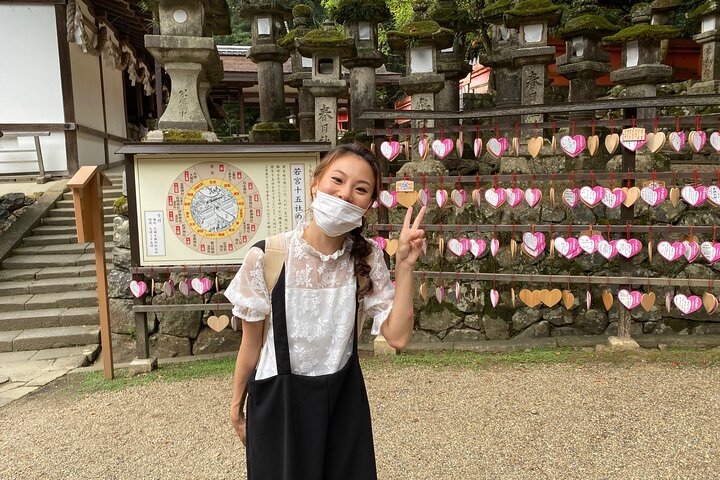
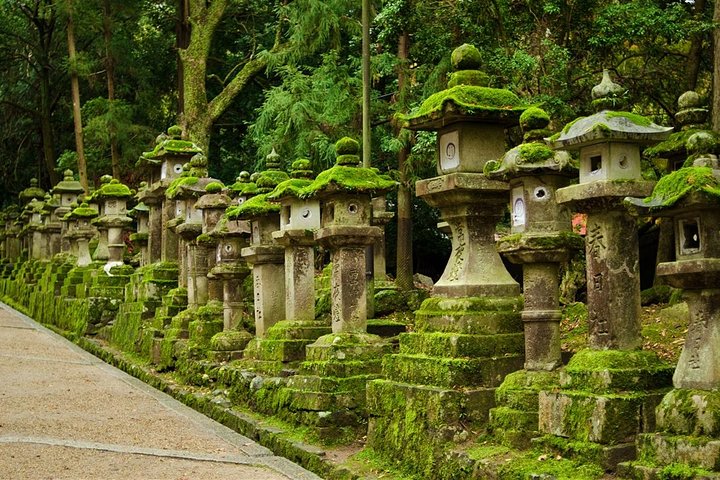
Beyond the shrine's offering hall, which can be visited free of charge, there is a paid inner area which provides a closer view of the shrine's inner buildings. Furthest in is the main sanctuary, containing multiple shrine buildings that display the distinctive Kasuga style of shrine architecture, characterized by a sloping roof extending over the front of the building.
30 minutesMt. Wakakusa
The grassy slope of the mountain is lined by cherry trees that are usually in full bloom around early April. A steep trail leads along the leftmost edge of the slope to a plateau halfway up the mountain with great views over the city. It takes about 15-20 minutes to reach the plateau and many people do not hike farther. An additional 20-30 minutes would get you to the mountain's peak.
30 minutesHoryu-ji Temple
Horyuji Temple (法隆寺, Hōryūji) was founded in 607 by Prince Shotoku, who is credited with the early promotion of Buddhism in Japan. Horyuji is one of the country's oldest temples and contains the world's oldest surviving wooden structures. It was designated a world heritage site in 1993. Horyuji's temple grounds are spacious and separated into two main precincts, the Western Precinct (Saiin Garan) and the Eastern Precinct (Toin Garan).
30 minutesNaramachi
Many of Naramachi's buildings in the Edo Period and earlier were machiya, long, narrow "townhouses" that served both as shops and as the living quarters of the local merchants. The store fronts of machiya were often kept narrow in order to save on taxes, which used to be calculated on a property's street access rather than its total area. Today, a handful of machiya have been preserved and made open to the public as museums.
30 minutesKofuku-ji Temple
The temple features several buildings of great historic value, including a five-storied pagoda and a three-storied pagoda. At 50 meters, the five-storied pagoda is Japan's second tallest wooden pagoda, just seven meters shorter than the five-storied pagoda at Kyoto's Toji Temple. Kofukuji's pagoda is both a landmark and symbol of Nara. It was first built in 730, and was most recently rebuilt in 1426. Neither pagoda can be entered by the public.
30 minutesYakushiji Temple
The main hall was rebuilt in the 1970s after being destroyed by fire and houses a Yakushi trinity, a masterpiece of Japanese Buddhist art. The East Pagoda is the temple's only structure to have survived the many fires that have beset the temple over the years, and dates from 730. It appears to have six stories, but is in fact only truly three-storied, like the West Pagoda.
30 minutesShinyakushiji Temple
Inside the main hall there are life size statues of 12 guardian deities surrounding a two meter tall statue of a seated Yakushi Buddha, which are the temple's main objects of worship. The Yakushi statue is made of wood while the guardians are made of clay. Each guardian has a different character and possesses a different weapon, and visitors can spend quite a while admiring them. There are also a few small paths around the temple grounds.
30 minutesNara National Museum
Both wings display the museum's permanent collection, which includes Buddhist statues, paintings, scrolls and ceremonial objects mainly from Japan. The new wing also houses temporary exhibitions, including an annual exhibition every autumn of treasures from Todaiji Temple. A ticket to the museum gives access to both wings, and English explanations are available throughout the museum.
30 minutesHeijō Palace Remains
During most of the Nara Period (710-794), Nara served as the capital of Japan and was known as Heijo-kyo. The Heijo Palace extended about one kilometer wide and one kilometer long and served as the site of the emperor's residence and government offices. For its great historical and cultural importance, the palace site is included as one of the UNESCO World Heritage Sites of Nara.
30 minutesToshodai-ji Temple
Toshodaiji's main hall (kondo) was re-opened in late 2009 after being renovated over a period of almost ten years, during which the building was dismantled and reconstructed. The temple's lecture hall (kodo) was originally an administrative building located in the Nara Imperial Palace and was later moved to Toshodaiji. Today, it is the only surviving building of the former palace.
30 minutesIsuien Garden
Isuien (依水園) is an attractive Japanese garden with a variety of features, such as the use of Todaiji Temple's Nandaimon Gate and Mount Wakakusayama as "borrowed scenery". Isuien means "garden founded on water", and the garden's name is derived from the fact that its ponds are fed by the small adjacent Yoshikigawa River. The Yoshikien Garden is located just on the other side of the river.
30 minutesYoshikien
There are three unique gardens within Yoshikien: a pond garden, a moss garden and a tea ceremony garden. So, a visit to Yoshikien provides the opportunity to see three different variations of Japanese gardens in one spot. If visitors still want to see more techniques of Japanese gardening, the Isuien Garden is located just across the small river.
30 minutesIncluded
- Licensed Local Guide
- Customizable Tour of your choice of 3-4 sites from 'What to expect' list
- Meet up with guide in Osaka/Kyoto
Not Included
- Food and Drink (for yourself)
- Entrance fees where applicable (for yourself)
- Transportation fees (for yourself)
- Any other personal expenses
Good to Know
- Infant seats available
- Service animals allowed
- Near public transportation
- Stroller accessible
- Surfaces are wheelchair accessible
- Transportation is wheelchair accessible
- Wheelchair accessible
- Most travelers can participate
- Face masks required for guides in public areas
- Hand sanitizer available to travelers and staff
- Social distancing enforced throughout experience
- Regularly sanitized high-traffic areas
- Gear/equipment sanitized between use
- Transportation vehicles regularly sanitized
- Guides required to regularly wash hands
- Regular temperature checks for staff
- Temperature checks for travelers upon arrival
- Paid stay-at-home policy for staff with symptoms
- Contactless payments for gratuities and add-ons
- This experience requires good weather. If it’s canceled due to poor weather, you’ll be offered a different date or a full refund
- This is a private tour/activity. Only your group will participate
- Confirmation will be received at time of booking
Tickets & Cancellation
You can present either a paper or an electronic voucher for this activity.
For a full refund, cancel at least 24 hours in advance of the start time of the experience.