You just got back from a week in Portugal with five friends. The trip was incredible. The group chat is full of photos, inside jokes, and "we need to do this every year" energy.
And then someone sends the spreadsheet.
Fourteen rows of charges. Three different currencies. A note that reads "I think Jake paid for the taxi on Tuesday but I'm not sure." Two people immediately dispute a line item. One person doesn't respond for a week. The warm afterglow of the trip curdles into a low-grade financial argument that drags on longer than the vacation itself.
Money is the single fastest way to turn a great group trip into a friendship-straining headache. Not because anyone is greedy or careless, but because tracking shared expenses across multiple people, multiple days, and multiple payment methods is genuinely hard — and most groups don't have a system for it.
Here's how to fix that.
The Real Problem With Group Trip Money
The issue isn't that your friends are bad with money. The issue is that group trip expenses are uniquely chaotic.
Think about what happens over a typical five-day trip with six people. Someone books the Airbnb and puts it on their card. Someone else covers the rental car. Dinners get split unevenly — one person grabs the check here, another person covers drinks there. Someone pays cash for a market run. Someone Venmos for a boat tour but forgets to include two people who joined late.
By day three, nobody has a clear picture of who has paid what. By day five, the numbers are a mess. And by the time everyone gets home, reconstructing the financial picture from memory, bank statements, and half-remembered Venmo transactions feels like forensic accounting.
This is how resentment starts. Not from bad intentions, but from bad systems.
Why Spreadsheets and Splitwise Fall Short
The two most common solutions for group trip expenses are shared spreadsheets and apps like Splitwise. Both are better than nothing. Neither is great.
Spreadsheets require someone to maintain them. That person becomes the unofficial trip accountant — a role nobody volunteers for and everyone resents. The spreadsheet lives in Google Drive, gets updated sporadically, and inevitably has formula errors that nobody catches until the final reconciliation. It also can't handle the complexity of real group travel: some expenses are shared equally, some are split by room, some only apply to four of the six people. Spreadsheets make this a nightmare of conditional logic.
Splitwise handles the math well, but it's designed for ongoing expense splitting between roommates, not the structured budgeting a trip requires. It tells you who owes whom after the fact, but it doesn't help you plan a group trip budget upfront, track spending against that budget in real time, or give everyone visibility into what the trip is actually going to cost before money starts flowing.
What groups actually need is a tool that handles the full lifecycle: setting a budget before the trip, tracking expenses during it, and settling up after — all in one place that everyone can see.
Step One: Have the Budget Conversation Before Anyone Books Anything
The most important financial decision of your group trip happens before a single dollar is spent. It's the conversation about how much everyone is comfortable spending.
This is also the conversation most groups skip entirely. We wrote a full guide to having the money talk without making it weird, but here's the short version: ask early, ask for ranges, and frame it as protecting the group experience.
A simple message like "Hey, what's everyone's all-in budget for this trip — flights, hotel, food, activities, everything?" does more to prevent financial tension than any expense-tracking tool ever could. When everyone's working from the same number, the planning process naturally stays within bounds.
Once you have a budget range, write it down somewhere the whole group can see it. Not buried in a text thread — somewhere persistent and visible. This is your financial guardrail for every decision that follows.
Step Two: Break the Budget Into Categories
A lump-sum budget number is a start, but it's not enough. "We're each spending $1,500" doesn't help you evaluate whether a $300-per-night hotel is reasonable until you know how much is left for flights, food, and activities.
Break your group trip budget into categories:
- Transportation (flights, rental car, gas, airport transfers, taxis)
- Accommodation (hotel, Airbnb, resort fees)
- Food and drink (restaurants, groceries, coffee, bars)
- Activities (tours, excursions, tickets, equipment rentals)
- Miscellaneous (tips, souvenirs, unexpected costs)
This doesn't need to be precise to the dollar. Rough allocations are fine. The point is to create a framework that helps the group make decisions. When someone suggests a $200-per-person wine tour, you can look at the activity budget and say "that's half our activity budget for the whole trip — is that how we want to spend it?" instead of just guessing whether it's too much.
If you're working with a tighter budget, check out our guide to adventure travel without breaking the bank for ways to maximize experience while minimizing cost.
Step Three: Track Expenses in Real Time, Not After the Fact
Here's where most groups go wrong: they treat expense tracking as a post-trip activity. Everyone comes home, dumps their receipts and bank statements into a shared doc, and tries to reconstruct what happened.
This approach fails for three reasons:
-
Memory is unreliable. By the time you're sorting expenses at home, you've already forgotten who paid for the second round at that rooftop bar, or whether the cab from the airport was split three ways or four.
-
You can't course-correct. If you're over budget on dining by day three, you'd want to know that so you can cook a few meals at the rental. But if nobody's tracking in real time, you don't find out until the trip is over and the money is spent.
-
The person doing the tracking burns out. If one person is responsible for logging everything, they spend the trip with their nose in their phone instead of enjoying the experience. And they start resenting it by day two.
Real-time tracking means logging expenses as they happen — or at least the same day. It means everyone in the group can see the running total, broken down by category. And it means the work is distributed, not dumped on one person.
Step Four: Make Who-Paid-What Visible to Everyone
The single biggest source of post-trip financial tension is asymmetric information. One person knows they've paid for $800 worth of group expenses. Everyone else thinks it was more like $400. When the true number comes out, it feels like an accusation — even though nobody did anything wrong.
The fix is simple: make every payment visible to the whole group, in real time. When someone puts dinner on their card, it gets logged with who paid, how much, and who it was for. When someone covers the rental car, same thing. At any point during the trip, anyone can open the tracker and see the full financial picture: total spending, spending by category, and the running balance of who's ahead and who's behind.
This transparency eliminates the awkward post-trip reconciliation almost entirely. There's no "I think I paid more than everyone else" because the numbers are right there. There's no dispute about whether a charge was shared or individual because it was categorized when it was entered. The money conversation happens passively, through data, rather than actively, through confrontation.
How Plan Harmony's Budget Feature Handles All of This
Plan Harmony was built specifically for group trip planning, and the budget feature reflects that. Here's what it actually does:
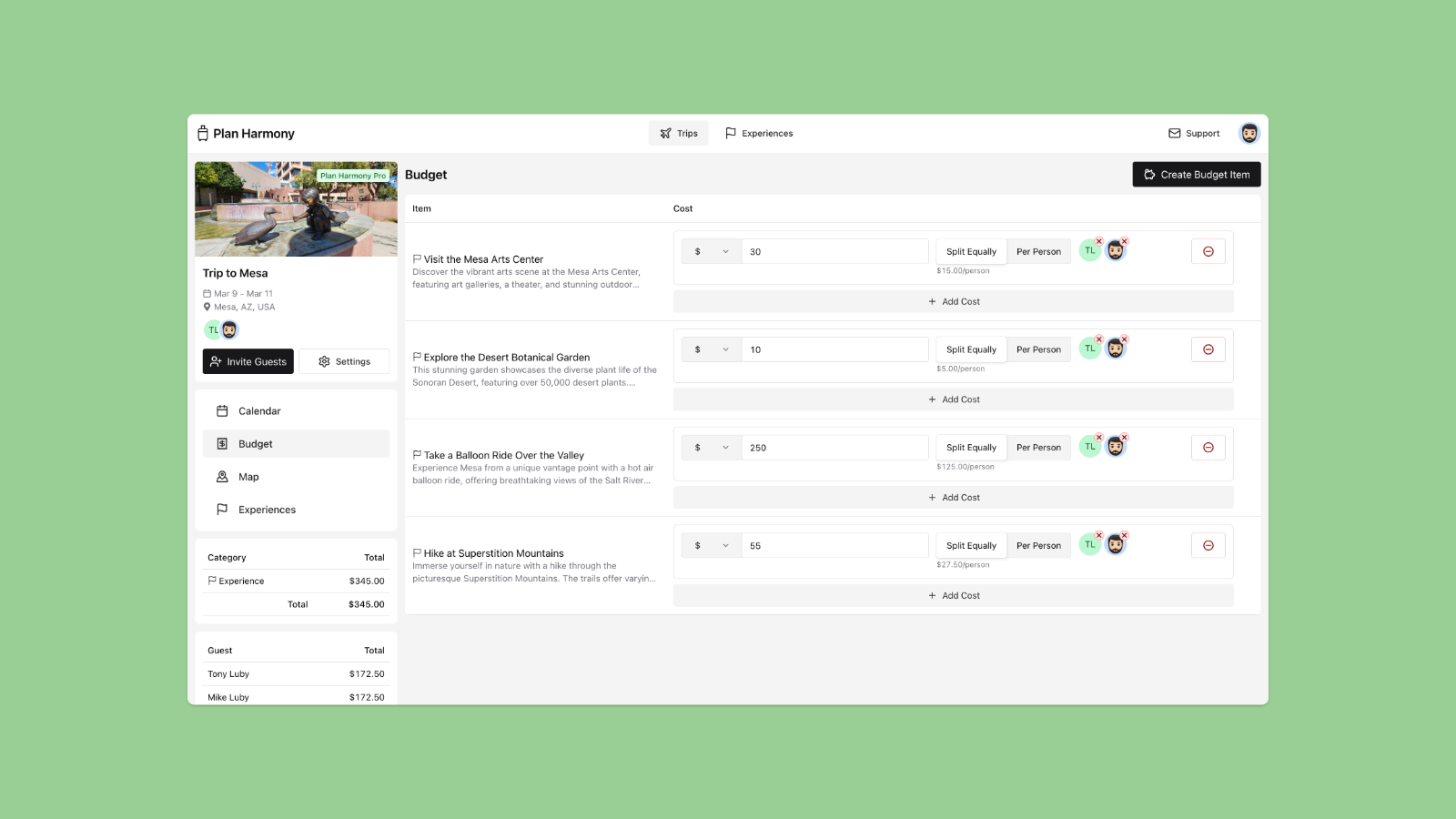
Set a trip budget upfront. When you create a trip, you can set an overall budget that's visible to everyone in the group. This becomes the shared reference point for all planning decisions — before anyone starts browsing hotels or booking excursions.
Break it down by category. The budget is divided into categories — transportation, accommodation, food, activities, and miscellaneous — so the group can see at a glance where money is going and where there's room to adjust.
Log expenses with who-paid-what visibility. Every expense gets tagged with who paid, the amount, the category, and who it was for. The whole group can see the ledger, so there's no information asymmetry and no end-of-trip surprises.
Track receipts. Upload photos of receipts directly to the expense entry. No more shoebox of crumpled paper, no more "I swear I paid for that but I can't find the charge."
See the running balance. At any point, anyone in the group can see the total spending against the budget, broken down by category. If you're trending over budget on dining, you know it on day three — not day ten.
The key difference between Plan Harmony's approach and a standalone expense splitter is context. Your budget lives alongside your itinerary, your accommodation details, and your group's plans. When you're deciding whether to add a $150 cooking class to the itinerary, you can see — right there, in the same tool — whether your activity budget can absorb it.
When to Use What: A Quick Framework
Not every trip needs the same level of financial infrastructure. Here's a rough guide:
Weekend trip with 2-3 close friends: You can probably get away with Venmo and a mental tally. Keep it simple.
4-7 day trip with 4-6 people: You need a real system. Set a budget, track categories, log who pays what. This is where Plan Harmony shines.
Week-plus trip with 6+ people: You absolutely need a dedicated budget tool with real-time tracking. The complexity scales non-linearly with group size and trip length. By day four of a ten-day trip with eight people, nobody can keep the numbers straight without a system.
Mixed-budget groups: If some people in the group have significantly different budgets, transparent tracking becomes even more important. It lets people opt in and out of specific expenses without awkwardness. Consider traveling during off-season to bring costs down for everyone.
Stop Letting Money Ruin Great Trips
The best group trips are the ones where nobody thinks about money during the trip and nobody argues about money after it. That doesn't happen by accident. It happens because someone set up a system before the first flight was booked.
Set a budget. Break it into categories. Track expenses as they happen. Make the numbers visible to everyone. And use a tool that's designed for the specific financial complexity of group travel — not a spreadsheet, not a roommate expense splitter, but something built for trips.
Start planning your trip on Plan Harmony — where budgets are shared, tracked, and settled without the awkward conversations.
Enjoyed this article?
Share it with fellow travelers planning their next adventure.