You're planning a trip to Lisbon with five friends. Everyone has opinions — one wants rooftop bars, another wants pastry tours, someone insists on a day trip to Sintra. You open ChatGPT and get a generic five-day itinerary that reads like a travel blog from 2019. It's a starting point, but it doesn't know your group, your budget, or the fact that half of you hate mornings.
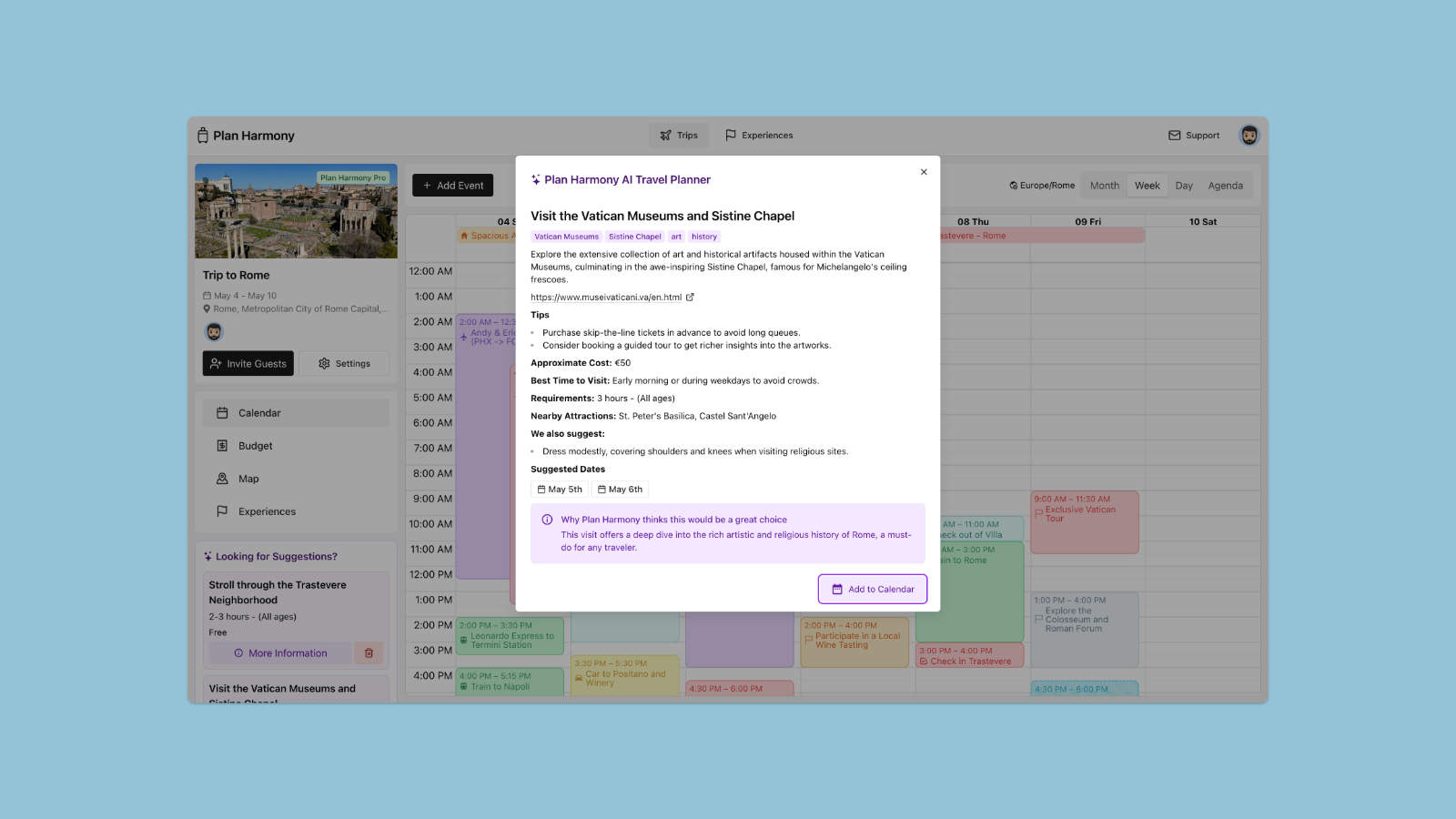
Plan Harmony's AI travel planner works differently. It generates suggestions based on your actual destination, trip dates, and group preferences — then puts those suggestions into a shared plan your group can vote on, edit, and build from.
What the AI Travel Planner Actually Does
When you create a trip in Plan Harmony and add your destination, the AI analyzes your trip details and generates activity suggestions tailored to where you're going and when. It considers:
- Seasonality and timing. Visiting Tokyo in cherry blossom season? The AI knows that and suggests hanami spots, timed-entry tickets, and parks worth visiting. Going in January? It shifts toward indoor experiences, onsen visits, and winter festivals.
- Activity variety. Instead of a list of 20 museums, you get a balanced mix — food experiences, outdoor activities, cultural sites, and nightlife — so the itinerary doesn't skew toward one person's taste.
- Local and lesser-known options. The AI draws from experience databases that include local favorites and off-the-beaten-path activities, not just the top-10 TripAdvisor results everyone's already seen.
- Practical logistics. Suggestions account for geography so you're not crisscrossing the city. Activities in the same neighborhood get grouped together.
How It Differs from ChatGPT
ChatGPT can generate a travel itinerary, but it gives you a static wall of text. Plan Harmony's AI does something ChatGPT can't: it puts suggestions directly into a collaborative trip plan where your group can interact with them.
The difference matters because trip planning isn't a solo activity. When ChatGPT gives you an itinerary, you still have to copy it into a doc, share it with your group, collect feedback via text, manually reconcile everyone's preferences, and rebuild the plan. That's not AI saving you time — it's AI creating a new task.
With Plan Harmony, AI-generated suggestions land in the shared trip workspace. Your group can vote on which ones to keep, reject the ones that don't fit, and add their own ideas alongside the AI suggestions. The plan evolves collaboratively instead of bouncing between one person's screen and the group chat.
Real Example: Planning a Week in Barcelona
Here's how it works in practice. You create a trip for Barcelona, June 14-21, with six travelers. The AI generates suggestions like:
- A Gothic Quarter walking tour (morning, day 1)
- Tickets to Park Guell with a timed entry (afternoon, day 2)
- A paella cooking class in El Born (evening, day 3)
- A day trip to Montserrat (day 5)
- A sunset sailing trip from Port Olimpic (evening, day 6)
Each suggestion appears as a card in your trip plan with a description, approximate cost, and time slot. Your group votes — the cooking class gets unanimous approval, but half the group swaps Park Guell for the beach. The plan updates in real time.
You didn't have to research Barcelona for three hours. The AI gave you a strong starting point, and the group refined it together.
Group Preferences Shape the Suggestions
The AI gets smarter as your group engages with it. When members add their interests during trip setup — foodie, adventure, nightlife, history, relaxation — the suggestions weight toward those preferences. A group of hikers planning Costa Rica gets different suggestions than a group of foodies planning the same destination.
This matters because the right experiences are different for every group. Generic travel recommendations assume a generic traveler. Plan Harmony's AI plans for your specific group.
Hidden Gems, Not Just Tourist Hits
One of the most common complaints about AI-generated itineraries is that they recommend the same tourist attractions every blog already covers. Plan Harmony's suggestions draw from curated experience databases that include local operators, niche tours, and activities that don't show up on the first page of Google.
That hole-in-the-wall ramen shop in Shimokitazawa. The street art tour in Bogota's La Candelaria. The vineyard in Chianti that only takes groups of six. These are the experiences that make a trip memorable — and they're exactly the kind of thing that gets lost when you're doing manual research across 15 browser tabs.
Stop Researching. Start Planning.
The AI travel planner isn't meant to replace your judgment — it's meant to replace the three hours of research you do before your judgment even kicks in. It gives your group a curated starting point, then gets out of the way so you can make it your own.
Try Plan Harmony's AI Travel Planner — tell it where you're going, and get a shared itinerary your whole group can build from.
Enjoyed this article?
Share it with fellow travelers planning their next adventure.