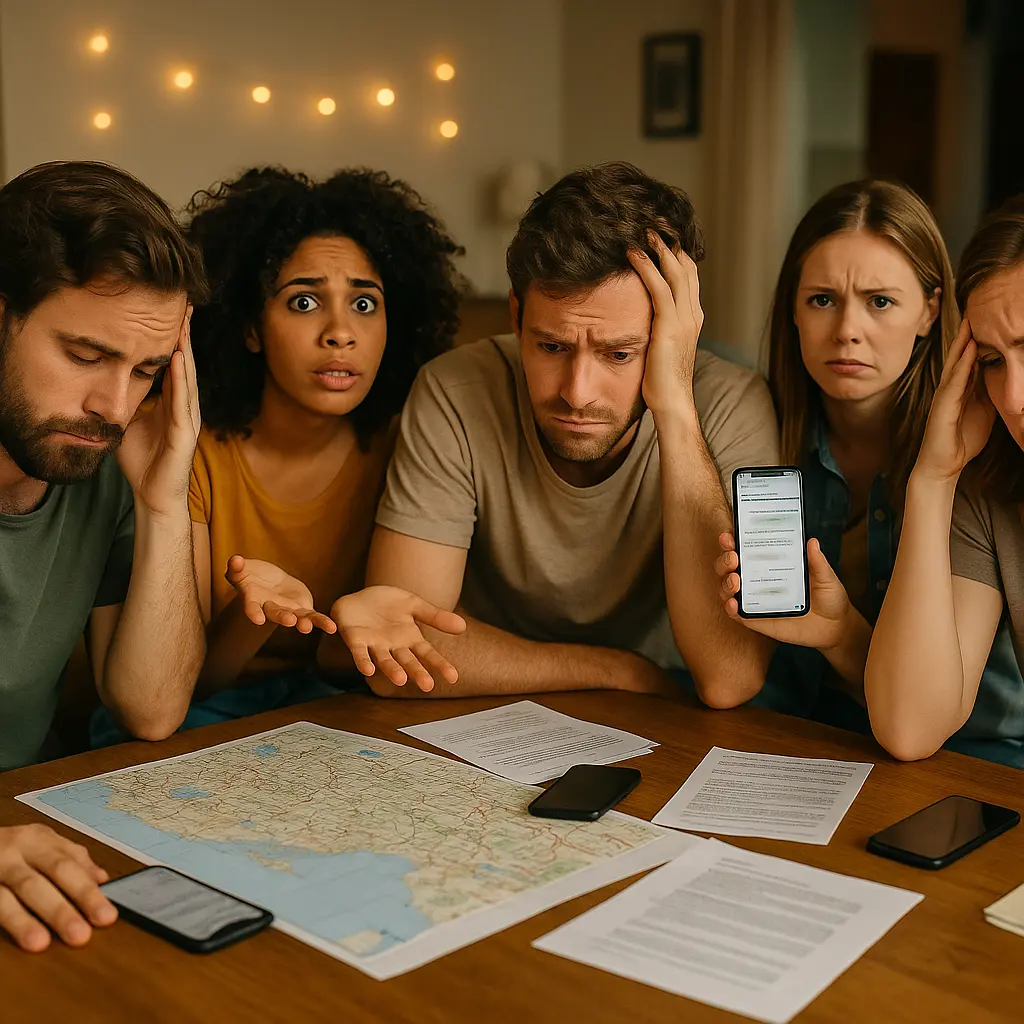
You can spot the divide within ten minutes of landing.
One person already has the transit route pulled up, the restaurant reservation confirmed, and a mental map of the neighborhood. The other person just wants to "wander and see what we find."
One of them is anxious. The other is annoyed. And neither understands why the other person can't just be normal about this.
This is the planner vs. free spirit divide, and it quietly derails more group trips than bad weather, flight delays, and overbooked hotels combined.
Two Perfectly Valid Philosophies (That Drive Each Other Insane)
Let's be clear: neither side is wrong.
The planner values intentionality. They've spent money and limited vacation days on this trip, and they don't want to waste either. An unstructured day feels like a squandered opportunity. When they see a group standing on a street corner debating what to do, they feel a physical discomfort — time is being burned. Their planning isn't about control; it's about making sure the group actually experiences the best of what they came for.
The free spirit values discovery. They see a vacation as an escape from the structured, scheduled, optimized grind of everyday life. An itinerary feels like a work calendar with better scenery. When every hour is accounted for, they feel suffocated. Their resistance to planning isn't laziness; it's a genuine belief that the best travel moments are the ones you don't see coming.
The conflict isn't about logistics. It's about identity.
The planner reads the free spirit's lack of structure as carelessness — a signal that they don't value the trip enough to prepare for it. The free spirit reads the planner's itinerary as controlling — a signal that they can't relax and need everything to go according to their script.
Both interpretations are wrong. But both feel deeply true to the person experiencing them.
What Each Side Is Actually Feeling
Beneath the surface disagreement, there's usually something more vulnerable:
The planner's hidden anxiety: If I don't plan, we'll waste the trip. And if the trip is bad, it's my fault because I'm the one who's "supposed to" have it figured out. The planning isn't a power grab — it's a coping mechanism for the fear of regret.
The free spirit's hidden need: I spend my entire life on someone else's schedule. Work meetings, deadlines, commitments. Vacation is the one time I get to exist without a plan. When someone schedules every hour, it triggers the same feeling of being managed that I'm trying to escape.
Neither person is trying to be difficult. They're both trying to protect something important to them — and they're each accidentally threatening the thing the other person is protecting.
The "Anchor and Drift" Framework
The solution isn't for one side to win. It's for both sides to get what they actually need — which, despite appearances, is entirely compatible.
The framework is simple: anchor the moments that matter, and let everything else drift.
How It Works
Step 1: Identify the anchors. These are the 2-3 things per day that genuinely require a plan — a reservation that needs to be made, an attraction with limited hours, a sunset spot that only works at a specific time. The planner owns this. Their job is to secure the things that would be lost without advance coordination.
Step 2: Leave everything else open. The spaces between anchors are unstructured by design. No plan, no expectation, no schedule. The group can wander, split up, nap, eat wherever, or stumble into something unexpected. The free spirit owns this. Their job is to keep the energy loose and spontaneous.
Step 3: Make both roles visible. This is the part most groups skip. When the structure isn't visible to everyone, the planner feels like nobody appreciates the anchors, and the free spirit feels like the open time is under threat. Both need to see the same plan.
Here's what this looks like in practice:
| Time | Plan |
|---|---|
| Morning | Open — sleep in, find a cafe, explore |
| 1:00 PM | Anchor: Lunch reservation at that place with the garden |
| Afternoon | Open — beach, museum, shopping, whatever |
| 7:30 PM | Anchor: Dinner at the spot that needs a reservation |
| After dinner | Open — rooftop bar, night market, or just hang |
The planner gets the security of knowing the important things are locked in. The free spirit gets the freedom of knowing most of the day is theirs. Both are satisfied, because both are getting what they actually care about.
How to Talk About It Without Making It Weird
The anchor-and-drift conversation doesn't need to be a confrontation. Here's how to bring it up naturally:
"I know some of us like having a plan and some of us like to wing it — and honestly, both are valid. What if we lock in the 2-3 things that actually need reservations or timing, and leave everything else completely open? That way we don't miss anything important but we also don't feel like we're on a tour bus schedule."
This works because it:
- Acknowledges both preferences without judging either
- Proposes a concrete framework, not an abstract compromise
- Uses specific language ("2-3 things") to reassure the free spirit that the plan isn't going to balloon
Build the Framework Into the Itinerary
The anchor-and-drift approach works best when everyone can see it. A shared itinerary that shows both the planned moments and the intentional open spaces gives the whole group confidence.
Plan Harmony makes this natural. You can build an itinerary that includes specific events alongside open blocks — and everyone in the group can see both. The planner can add the anchors, and the free spirits can see exactly how much unstructured time they have. If someone discovers something amazing during the drift, they can add it to the trip in real time for others to join.
The result is a trip that has structure and spontaneity — a plan that protects the important moments without suffocating the unexpected ones.
Different Styles, Same Trip
The planner and the free spirit don't need to change who they are. They just need a framework that honors both approaches — and the visibility to trust that it's working.
Anchor the things that matter. Let everything else happen. And put it all in a place where everyone can see it.
Plan your next trip with Plan Harmony — where structure and spontaneity coexist.
The planner-vs-free-spirit divide is one of several dynamics that quietly shape group trips. Read about the real reason group trips go wrong — mismatched expectations nobody surfaced — and why the planner's resentment cycle compounds when structure-seekers carry the load alone.
Enjoyed this article?
Share it with fellow travelers planning their next adventure.